
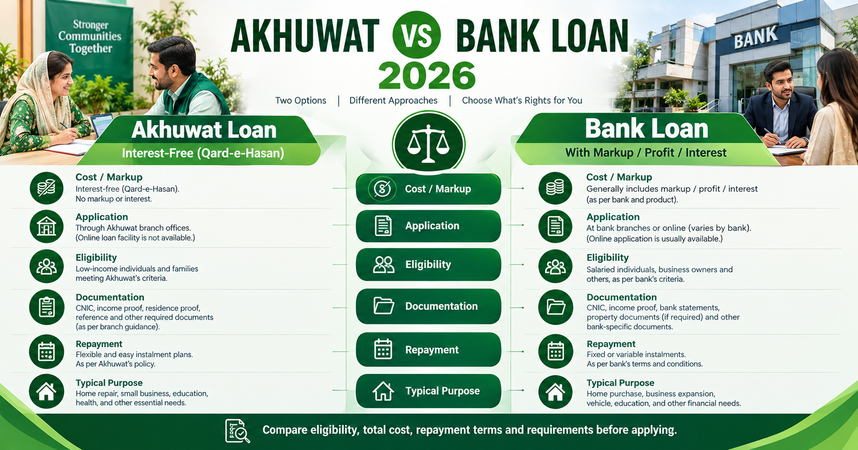
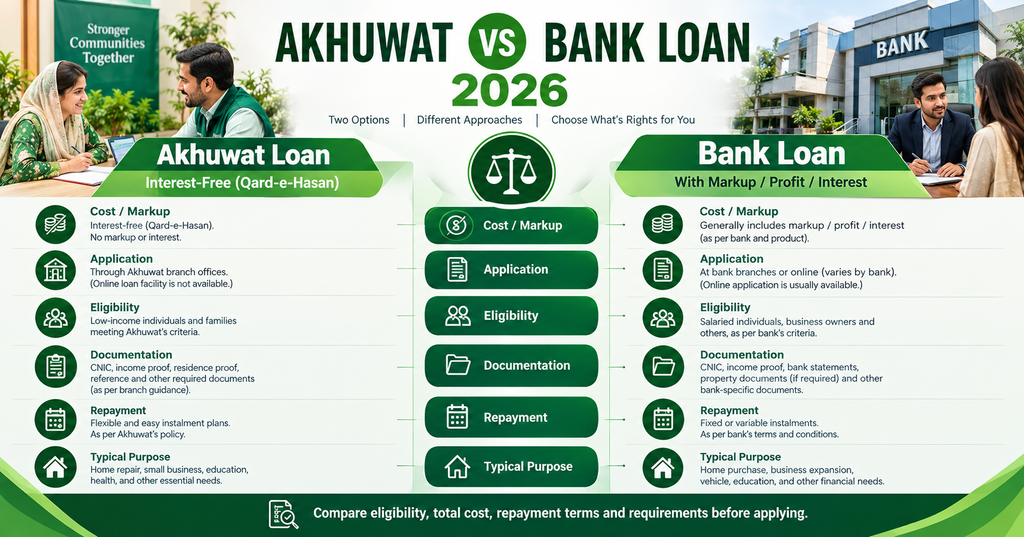
When people need financing in Pakistan, they may compare an Akhuwat Loan vs Bank Loan. Both can provide access to funds, but they operate according to very different models.
Akhuwat’s Islamic Microfinance program is based on Qarz-e-Hasna, or interest-free lending. Conventional banks generally provide financing under commercial lending structures that may involve interest or markup, depending on the product.
The better option depends on the borrower’s eligibility, purpose, repayment ability, and preferences.
Akhuwat vs Bank Loan at a Glance
| Feature | Akhuwat | Conventional Bank |
|---|---|---|
| Core model | Interest-free microfinance | Commercial financing |
| Main objective | Financial inclusion/social support | Commercial lending |
| Eligibility | Program-specific | Bank/product-specific |
| Loan purpose | Approved microfinance categories | Varies widely |
| Online application | Akhuwat currently says no | Depends on bank |
| Branch process | Yes | Varies |
| Interest/markup | Akhuwat microfinance is interest-free | Often applies depending on product |
What Makes Akhuwat Different?
Akhuwat’s philosophy is centered on Qarz-e-Hasna and social solidarity. It says its microfinance strategy is intended to support people in need through interest-free financing.
The organization focuses on financial inclusion rather than conventional commercial lending.
What Is a Bank Loan?
A bank loan is financing provided by a regulated financial institution under a defined commercial product.
Banks may offer:
- Personal financing
- Business financing
- Home financing
- Vehicle financing
- Agricultural financing
- Other products
Each bank sets its own eligibility criteria, pricing, documentation, and repayment conditions.
Interest vs Interest-Free Financing
One of the most important differences is the financing structure.
Akhuwat’s microfinance program is based on interest-free Qarz-e-Hasna.
A conventional bank loan may involve interest or markup.
Therefore, a borrower who specifically wants an interest-free financing model may find Akhuwat more aligned with that preference, assuming they qualify.
Eligibility Differences
Akhuwat’s microfinance eligibility is designed around its specific social-finance programs.
Its published process includes requirements such as:
- Valid CNIC
- Age criteria
- Two non-family guarantors
- Branch-area residence
- Appropriate loan purpose
- Other assessment requirements
Banks use their own underwriting standards, which can involve income, employment, credit history, debt obligations, collateral, and other factors depending on the product.
Loan Amounts
Akhuwat’s current published products include:
- Family Enterprise: Rs. 10,000–Rs. 50,000
- Agriculture: Rs. 10,000–Rs. 50,000
- Housing: Rs. 100,000–Rs. 1,500,000
Banks can offer much broader financing ranges, depending on the institution and product.
Therefore, someone requiring a large commercial facility may need to consider banking options, while someone seeking eligible microfinance may find Akhuwat more relevant.
Application Process
Akhuwat currently states that it does not offer loans online and directs applicants to its branches.
Banks vary. Some allow online applications, while others require branch visits or additional verification.
Repayment
Both types of financing require responsible repayment.
Akhuwat publishes different durations according to its products. For example, its Housing Loan currently has a published duration of 36–108 months.
Bank repayment terms depend on the individual product and agreement.
Which Is Better for a Small Business?
For an eligible person seeking a small amount to establish or expand a family enterprise, Akhuwat’s Family Enterprise Loan may be worth investigating.
For larger commercial financing, a bank may offer more suitable products.
Which Is Better for Home Financing?
Akhuwat’s Housing Loan is designed around specified renovation and construction needs.
A bank’s home finance product may be designed for property purchase, construction, or other larger-scale financing.
Therefore, the purpose matters more than simply choosing one institution over another.
Which Is Better for Low-Income Borrowers?
Akhuwat may be particularly relevant to people seeking interest-free microfinance and who meet its program criteria.
However, applicants should never assume approval merely because they have low income.
Advantages of Akhuwat
- Interest-free microfinance model
- Focus on financial inclusion
- Family enterprise support
- Agriculture financing
- Housing financing
- Branch-based community approach
Potential Advantages of Banks
- Larger range of financial products
- Potentially larger financing amounts
- Digital services may be available
- Different repayment structures
- Products for many income levels
What Should You Choose?
Ask yourself:
Do you specifically want interest-free financing?
If yes, investigate whether Akhuwat’s Qarz-e-Hasna model fits your needs.
Do you need a larger commercial loan?
A bank may provide more suitable products.
Do you need a small family-business loan?
Akhuwat’s Family Enterprise Loan may be relevant if you qualify.
Do you need home purchase financing?
Compare the exact purpose of Akhuwat’s Housing Loan with the bank’s home-finance products.
Scam Awareness
Regardless of which option you choose, never give banking passwords, PINs, OTPs, or money to an unofficial agent.
Akhuwat specifically warns that fraudsters misuse its name.
Frequently Asked Questions
Is Akhuwat better than a bank?
There is no universal answer. It depends on the borrower’s purpose, eligibility, required amount, and financing preference.
Is Akhuwat interest-free?
Its Islamic Microfinance model is based on interest-free Qarz-e-Hasna.
Can I apply for Akhuwat online?
Akhuwat currently says loan applications are not offered online.
Can banks offer larger loans?
Depending on the institution and product, banks may offer larger commercial financing facilities.
Final Verdict
The Akhuwat vs Bank Loan comparison is not really about one option being universally better.
Akhuwat may be more appropriate for an eligible person seeking interest-free microfinance for an approved purpose. A bank may be more suitable for someone needing larger commercial financing, specialized products, or digital banking services.
The right decision comes from comparing the exact loan purpose, total repayment obligations, eligibility criteria, and terms rather than choosing solely on the name of the lender.